
Air Duct Cleaning: Repair or Replace? How Hell’s Kitchen Homeowners Decide
Cleaning flex duct that’s crushed in three places and leaking conditioned air into a wall cavity doesn’t improve your air quality. It just means you paid to clean something that still doesn’t work. The repair-or-replace question for ducts in Hell’s Kitchen is mostly about geometry, material condition and sealing integrity, not age. If the system can be brought back to a performance standard, cleaning makes sense. If it can’t, cleaning is money spent on a problem you’ve only hidden. If you’d rather not sort that out alone, call (833) 468-5937 and we’ll look with you.
Why age alone is the wrong way to decide
A duct system’s age tells you almost nothing useful on its own. What matters is what’s physically inside the walls of your Hell’s Kitchen apartment or building. A fifteen-year-old system that was installed well and sealed correctly can be cleaned and sealed back to a solid standard. A five-year-old retrofit that was rushed through a tight ceiling plenum and pinched a flex run across a pipe can be failing right now.
We’ve seen both in Hell’s Kitchen. The deciding factors come down to four things:
- Geometry: Is the duct run still a straight, unobstructed path, or does it kink, collapse or compress around corners?
- Material condition: Is the flex liner intact, or has it torn, sagged or collected moisture?
- Sealing integrity: Are the joints, seams and connections still sealed, or is conditioned air escaping into a wall cavity?
- Connection: Is every run actually connected at both ends, or has a boot come loose above a ceiling?
If all four hold up, cleaning is usually worthwhile. If two or more are compromised, you’ll want to know before anyone runs a brush through the system. That’s the point of an inspection, and it’s the step a lot of quotes skip.
The duct defects that make cleaning a poor investment
There are specific failure modes we look for in Hell’s Kitchen buildings, and each one changes the recommendation. If you see these, the honest answer is often repair or replacement before cleaning makes sense. Four defects stand out:
- Crushed or kinked flex duct. Flex is forgiving until it’s bent past its limit. Once it’s collapsed or pinched, airflow drops and the duct can’t be cleaned back to a working standard, because it never worked well to begin with.
- Failed duct board seams. Duct board is common in some Hell’s Kitchen retrofits. When seams fail, insulation fibers can enter the airstream and sealing practically can’t be restored without rebuilding the section.
- Corroded metal ductwork. Older metal runs in pre-war Hell’s Kitchen buildings are sometimes rusted through at joints, especially where moisture has sat. Cleaning a rusted-through run doesn’t fix the leak.
- Disconnected duct runs. A run that’s come loose above a ceiling is blowing conditioned air into the void. Cleaning that run solves nothing until it’s reconnected.
None of these are visible from a vent cover. That’s why the next step matters more than any of them.
Why camera inspection should come before any cleaning decision
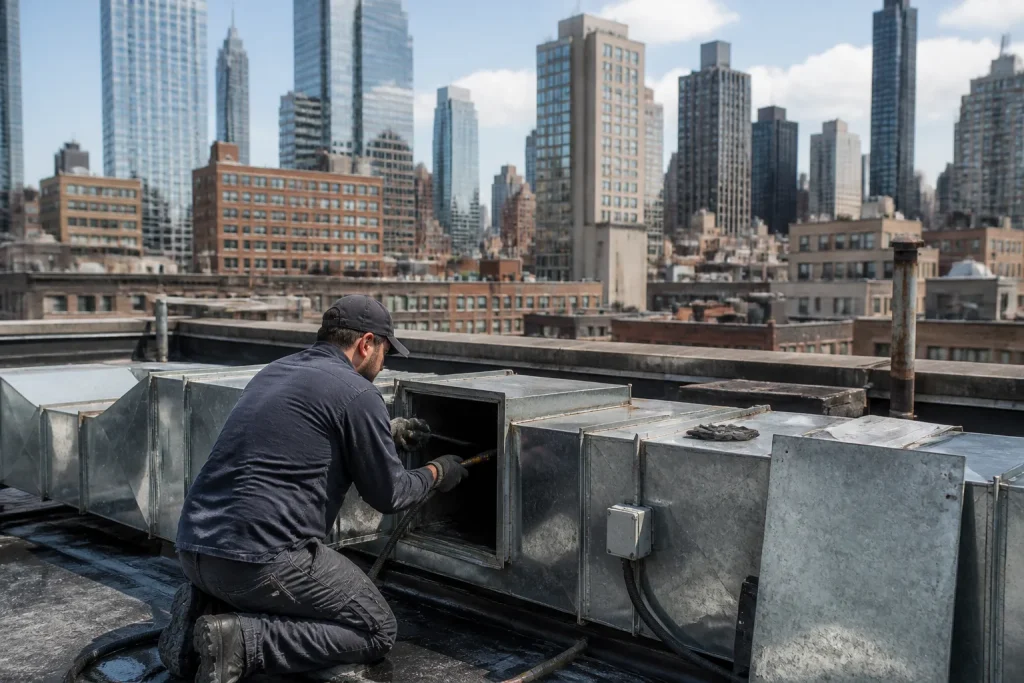
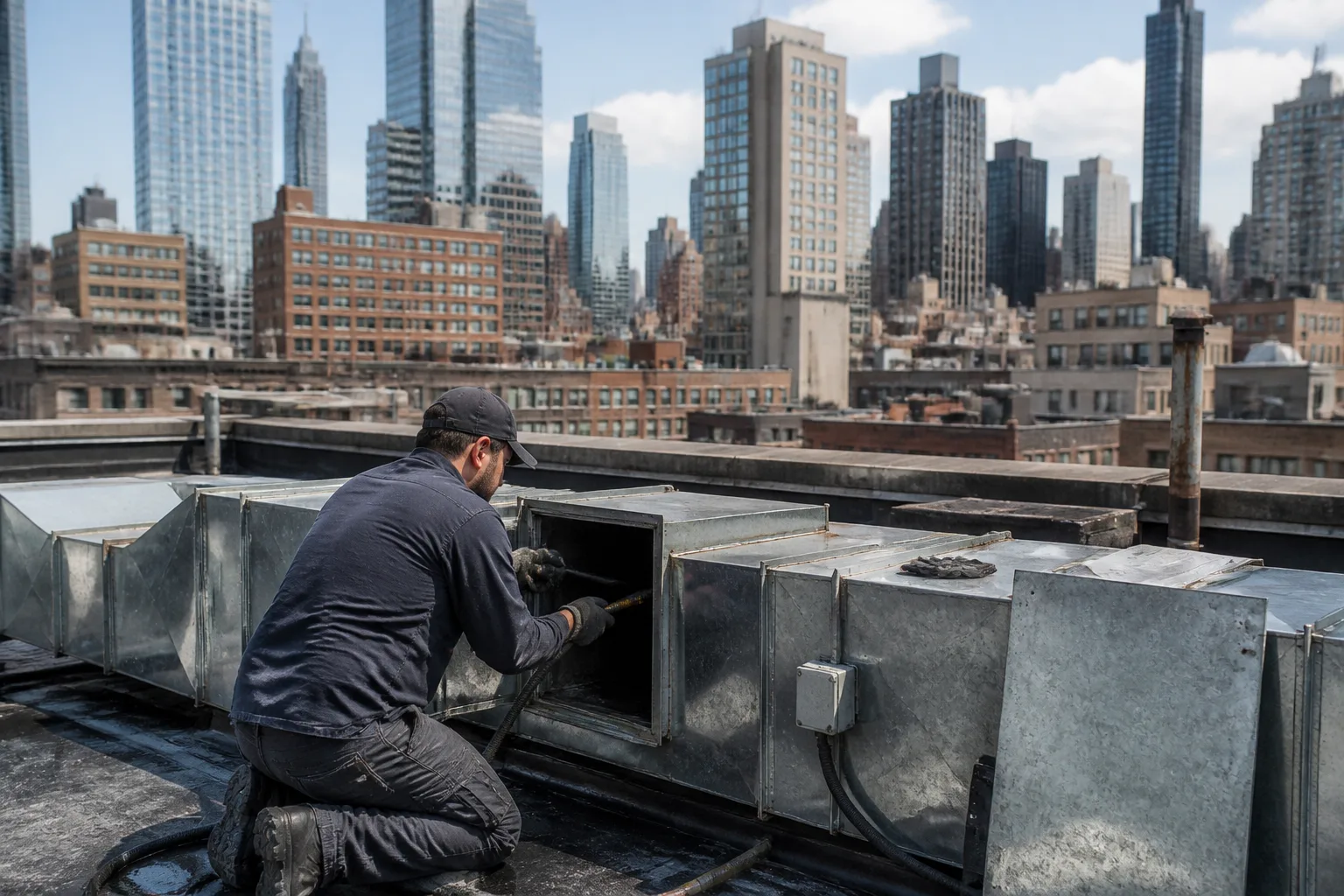
Before we recommend cleaning or replacement in Hell’s Kitchen, we look inside the system with a camera on industrial-grade equipment. You can’t make a fair call about a duct system by peering through a floor register. The hidden runs above ceilings, inside soffits and behind walls are where the real condition lives.
A proper inspection identifies damage where it actually is: the crushed flex behind a bathroom ceiling, the failed seam in a supply trunk, the disconnected boot feeding a bedroom. That’s where equipment like Abatement Technologies containment and negative-air pressure comes in, because any inspection or cleaning that opens the system should also control what’s released into the room.
If you want the full picture of what to expect from a real air duct cleaning visit, that page walks through the process end to end. The key point here is simple: don’t accept a cleaning quote that wasn’t preceded by an inspection.
When duct sealing is the right middle path
Sometimes the answer isn’t clean-only and isn’t full replacement. Duct sealing is a middle path that fixes air loss without ripping out a system that’s structurally sound. Where the ducts are intact but leaky at seams and joints, sealing restores performance for a fraction of replacement.
Two approaches come up most often:
- Mastic application: A brush-on sealant applied directly to accessible joints and seams. Effecting where ducts run through open ceilings or mechanical spaces.
- Aeroseal-style sealing: A sealed-fog process that reaches joints and small holes not directly accessible. Better for Hell’s Kitchen buildings with finished ceilings and tight chases.
Sealing works best on systems where geometry and material are already in decent shape. If flex runs are crushed or metal is corroded through, sealing an intact but poorly connected system won’t solve the underlying airflow problem. That’s why inspection comes first. Once you know the condition, sealing often emerges as the practical fix that rescues a set of ducts otherwise facing replacement.
If air loss and leaks are the issue rather than cleanliness, our hvac cleaning service often pairs with sealing to get both the system and its associated components to a working standard.
Repair or replace: how the cost math works in Hell’s Kitchen
Here’s where Hell’s Kitchen location matters. The math on replacement ductwork in a pre-war walk-up versus a post-2000 high-rise is completely different, and it has less to do with equipment cost than access and labor complexity.
Pre-war buildings often hide ducts in chases, soffits and ceiling voids that were not designed for central air. Replacing a run can mean opening plaster, working around original structural elements, and closing it all back up. The labor dominates.
Post-2000 construction usually has engineered mechanical spaces and accessible plenums. Replacement is more contained, but systems in newer high-rises are often tightly packed with other MEP services, so routing is still a factor.
This is why a flat “replace it” or “clean it” answer without knowing your building is unreliable. A typical decision framework looks like this:
- Clean only: Geometry intact, material sound, sealing holds, runs connected. Cost is lowest; the main job is removing accumulated particulate and microbial load.
- Clean and seal: Geometry and material sound but joints leaking. Cost sits between clean and replace, with most of the system preserved.
- Repair specific runs: Isolated damage (a crushed section, a disconnected boot). Cost tracks the scope of the damaged section.
- Replace: Corrosion, failed duct board, or crushed flex across multiple runs. Replacement is often the only path to a system that actually works.
We’ll give you one flat price per system based on the written estimate after inspection, so you’re not guessing which category you fall into. The written estimate sets the final price. For a clear look at the cleaning side of the ledger, see our Air Duct Cleaning Hell’s Kitchen page.
One fire-safety add-on worth keeping on your radar while you’re at it: if your dryer vent is also aging in a Hell’s Kitchen building, dryer vent cleaning belongs on the same list, because lint buildup is a real fire risk and it’s often the last thing anyone thinks to check.
When to call a pro
Call us if any of these sound like your Hell’s Kitchen home:
- You’re getting weak airflow from some vents and strong from others (a sign of crushed or disconnected runs).
- Dust returns quickly after cleaning, which often points to open leaks rather than cleanliness.
- You’ve recently renovated and aren’t sure the ceiling runs went back together correctly.
- You can see the ductwork and it looks collapsed, torn or rusted at the joints.
- You’re about to spend money on cleaning and want to know whether it will actually help.
A camera inspection settles it in most cases. You’ll want our technicians, who have up to 14 years of experience, on the sensors. If you aren’t sure whether the part you need is a fix, a seal or a full replacement, we can tell you before any work begins. The one thing we won’t do is run a brush through a system we know is failing.
The comfort systems that sit on the other side of your ducts (the furnace, the air handler, the filtration) benefit from being paired with a proper air-quality setup. That’s where familiarity with Honeywell and Aprilaire systems comes in: a whole-home filter or humidity control has to match the ductwork it’s feeding, and those two brands are the ones we see most often across Hell’s Kitchen systems.
The Bottom Line
Duct decisions come down to condition, not age. If the geometry, material, sealing and connections are still sound, cleaning (and possibly sealing) makes sense. If flex is crushed, duct board seams have failed, metal is corroded or runs have disconnected, cleaning is a poor investment until the damage is fixed. Get a camera inspection first. The real cost math in Hell’s Kitchen depends heavily on whether you’re in a pre-war building or a newer high-rise, and the only honest way to know is to look inside.
If you’re in Hell’s Kitchen and need help deciding between repair, sealing or replacement, Air Duct Cleaning Hell’s Kitchen offers free estimates. Call (833) 468-5937. We answer 24/7. Fast dispatch from 7am to 7pm, Sunday through Friday.
Frequently Asked Questions
Replace only when the ductwork can’t be restored to a working standard: crushed flex, corroded metal, failed duct board seams or disconnected runs. Otherwise cleaning and sealing usually preserve the system for less. A camera inspection makes the call based on actual condition, not age.
Always inspect before cleaning. A proper inspection tells you whether cleaning will help or whether the system needs repair first. Cleaning a failing system wastes money; fixing it first means the cleaning actually delivers the improvement in air quality you’re after.
Duct sealing is the middle path between cleaning and replacement. When ducts are structurally sound but leaking at joints and seams, sealing rescues part of the system without the cost of replacement. It works best where the geometry and material are already intact.
It can’t be pinned to a schedule without an inspection. Access is the dominant cost in pre-war Hell’s Kitchen buildings, so timelines vary widely. Ask for a written estimate after inspection, and the estimate should tell you the scope and the final price.
If you’d rather not DIY any of this, call (833) 468-5937. We answer 24/7. Fast dispatch from 7am to 7pm, Sunday through Friday.
Written by the team at Air Duct Cleaning Hell’s Kitchen.
Need Air Duct Cleaning Help?
Call Air Duct Cleaning Hell's Kitchen - the local pro we connect you with is licensed and insured, here with fast help in Hell's Kitchen.
(833) 468-5937