
Emergency Air Duct Cleaning Near Me: What Hell’s Kitchen Homeowners Should Do First
Calling a duct cleaner the moment you smell smoke in your vents is the wrong first move. Running the system to “clear it out” can push combustion byproducts, soot, or mold spores through every room in your apartment. What actually protects your home, your air, and your insurance claim is the sequence you follow in the first hour. If you’d rather have a professional walk you through it, call (833) 468-5937. We answer 24/7, with fast dispatch from 7am to 7pm, Sunday through Friday.
What Counts as a Duct Emergency in Hell’s Kitchen?
True duct emergencies in Hell’s Kitchen fall into three categories: fire or smoke intrusion into the HVAC system, water intrusion around ducts or HVAC components, and vermin intrusion (rodents, birds, or insects) that leaves contamination inside the ductwork. Each one has a different correct first response, and each one gets worse if you run the system before it’s addressed.
Hell’s Kitchen buildings make these situations sharper than they might be in a suburban house. Many apartment buildings here are older walk-ups and mid-rises with shared chases, rooftop air handlers, and duct runs that pass through multiple units. A smoke event on one floor can push contamination into several apartments through a common return. Water from a burst riser or a roof leak can soak insulation inside a duct before anyone notices a stain on a ceiling. And because space is tight, a single compromised vent has less slack to work with.
The order below is what matters. Step one is the same in every case: shut the HVAC system down before you do anything else.
Step One: Shut Down the System and Document Everything
Turn off the HVAC system at the thermostat, and if you can safely reach it, at the air handler or furnace breaker. Don’t run the fan “to see if it helps.” In a smoke event, that fan becomes a distribution system for everything you’re trying to contain. In a water event, it can push moisture into parts of the system that were dry.
Then document. This is the part most people skip and later regret:
- Photograph everything. Vents, filters, visible soot, water stains, the thermostat, any damage to the air handler. Wide shots and close-ups. Timestamps on your phone photos help.
- Note the time and what happened. When did you first notice the smell or stain? What were you doing when it appeared?
- Notify your building super or management. In a multi-unit Hell’s Kitchen building, a duct issue is rarely one apartment’s problem. Get it in writing (a text is fine) so the record exists.
- Don’t throw away the filter. A filter can show what entered the system and is useful evidence for an insurance adjuster.
If you’re a renter, document the same way and keep your landlord in the loop from the start. If you own the unit, your building’s insurance and your own policy may both be relevant, so keep every photo and every message.
The Three Common Duct Emergencies and the Right First Move for Each
Each of these scenarios has a different correct response, and getting it wrong can spread contamination or weaken your insurance position. Here’s how to handle each one in the first hour.
1. Fire or smoke intrusion. Shut the system off. Open windows if it’s safe to ventilate, but don’t run fans or the HVAC. Call your super immediately, then your insurer, then a duct professional. Soot particles are fine and travel easily through ductwork; getting the system cleaned and sanitized with proper containment is not a job for a shop vac.
2. Water intrusion near HVAC components. Shut the system off, especially if water reached the air handler or any electrical component. Photograph the water line and any staining. Don’t run the system to “dry it out” – that can push moisture through ducts and set up mold growth in insulation. If the water came from a burst pipe or roof leak, notify the building and your insurer before cleaning begins.
3. Vermin intrusion. Shut the system off if you see droppings, nesting material, or a dead animal near a vent or in a return. Don’t vacuum it yourself with a household vacuum – that aerosolizes contamination. Photograph what you see, notify the building, and get a professional assessment. This scenario often needs both cleaning and duct repair and sealing, because the animals got in through a gap that’s still open.
What Information to Have Ready When You Call
When you call a duct professional after a smoke, water, or vermin event, the more precise your details, the more accurate the plan and the estimate. Have these ready:
- System type: forced-air furnace, heat pump, or a building-wide system. Note whether it’s a rooftop unit serving the whole building or an in-unit air handler.
- Number of vents and returns: count them if you can. Supplies and returns separately if possible.
- Visible damage: soot, staining, water lines, droppings, debris, torn flex duct, disconnected runs.
- Whether the super or building management has been notified, and whether the building has its own contractor.
- Your insurance status: whether you’ve opened a claim, and whether an adjuster has visited.
That information lets a professional recommend the right scope before anyone arrives – and a good one will tell you whether you need a standard cleaning or emergency-response work. If you’re not sure what you’re looking at, that’s fine. Describe what you smell and see, and we can help you sort it out. Call (833) 468-5937. We answer 24/7.
What Emergency Duct Response Looks Like Versus a Standard Cleaning
A standard air duct cleaning visit and an emergency-response visit are not the same job with a different price tag. They use different equipment and different protocols, and the difference matters in a smoke or water event.
Emergency and remediation-grade work usually involves:
- Negative-air containment using equipment like Abatement Technologies units, so contamination is pulled out of the space rather than released into it.
- HEPA filtration throughout the process, not just at the end.
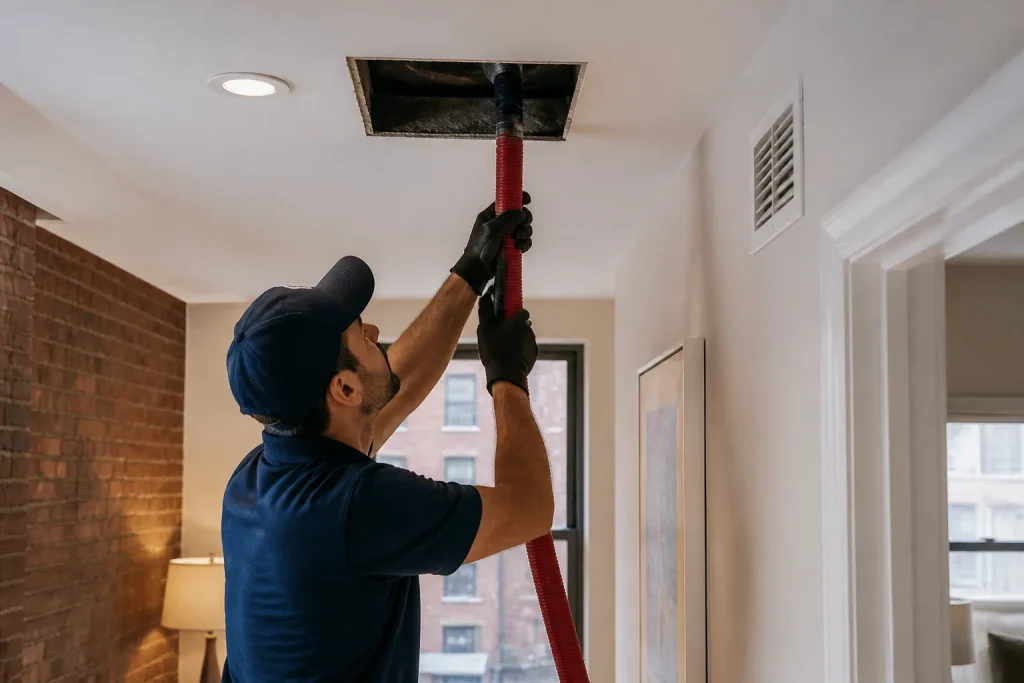
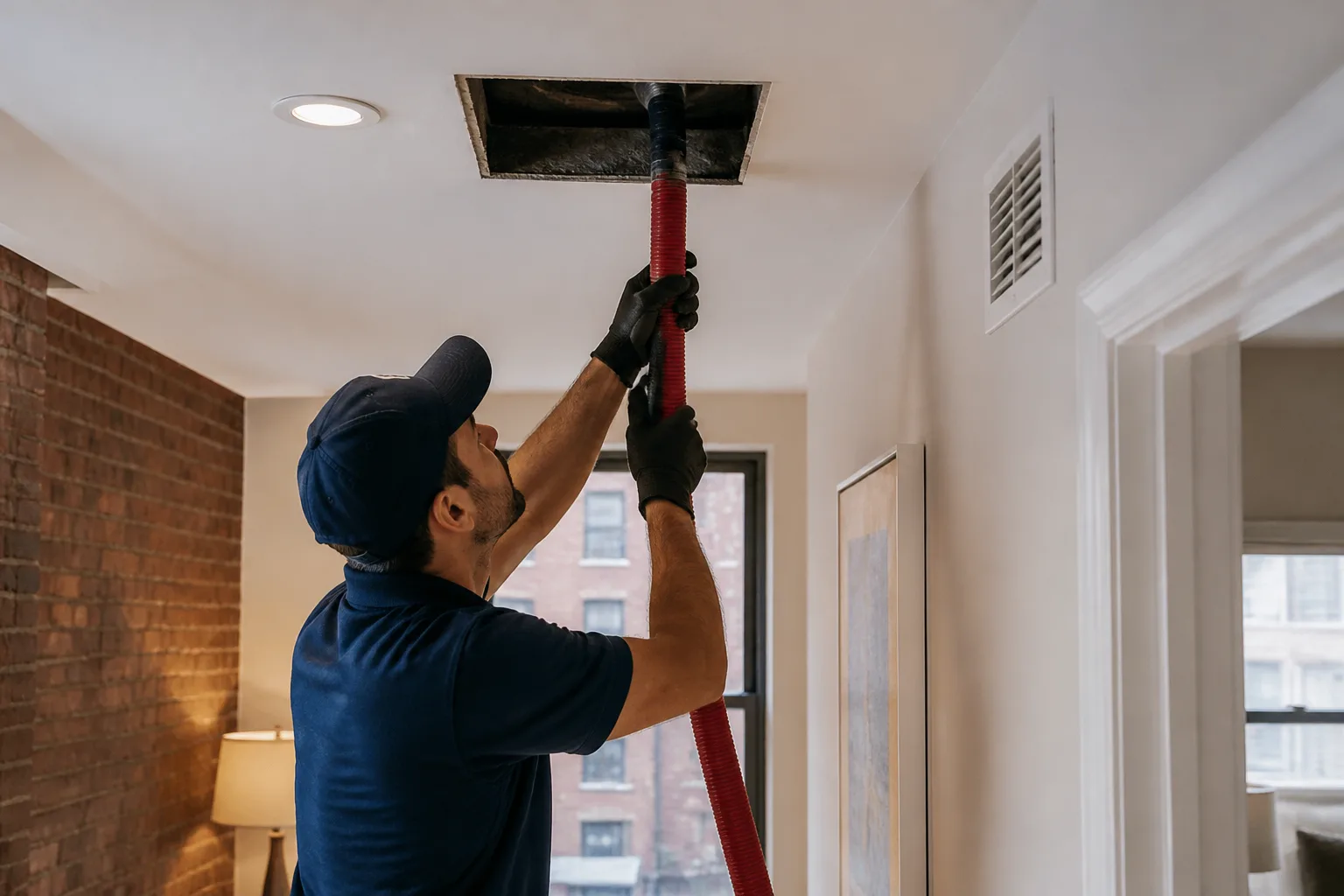
- Rotobrush rotary-brush systems to agitate and remove bonded soot or debris from duct walls, paired with Nikro negative-air vacuums to capture what’s loosened.
- Post-clean sanitizing with products like Guardsman, aimed at allergens, mold spores, and microbial contamination at the source.
- Documentation before and after, including photos, since an insurer will often ask for proof of the condition and the work performed.
If your system includes whole-home filtration or humidity control from brands like Honeywell or Aprilaire, an assessment should account for those components too. Filters and media may need replacement, and the system needs to be returned to correct operation, not just cleaned around.
For a routine cleaning, our air duct cleaning service covers the standard scope. For a smoke, water, or vermin event, tell us on the call and we’ll plan the response accordingly.
Red Flags That Mean Cleaning Alone Isn’t Enough
Sometimes the right answer is more than a cleaning. If you see any of the following, duct repair and sealing or partial replacement needs to be part of the scope, and a cleaning-only quote is a sign the company hasn’t looked closely enough.
- Disconnected or crushed flex duct. Cleaning a run that isn’t connected does nothing for air quality, and it can leave contamination loose in the system.
- Visible mold growth on duct surfaces or insulation. Cleaning without addressing the moisture source means it returns.
- Water-soaked insulation. Insulation that has been wet generally needs replacement, not drying.
- Pest entry points still open. Cleaning without sealing the gap that let animals in guarantees a repeat.
- Structural damage to ductwork from a fire or water event, including warped or collapsed sections.
In Hell’s Kitchen apartments in older buildings, we often find that the duct problem and the building problem are linked – a shared chase with a gap, a rooftop unit past its service life, or flex duct that was never properly supported. Fixing the duct without fixing what caused the problem just resets the clock. Our Air Duct Cleaning Hell’s Kitchen page explains the full service scope, and our duct repair and sealing work addresses the underlying cause.
When to Call a Pro
If you smell smoke, see water staining near a vent or air handler, find droppings or nesting material, or notice a musty smell that gets stronger when the system runs, stop running the system and call. These are not situations where a household vacuum and a box of filters will do the job, and mishandling them can spread contamination or undermine an insurance claim.
Related services in Hell’s Kitchen: if you’re also noticing lint buildup or slow drying, ask about dryer vent cleaning, and if the system itself is due for service, our HVAC cleaning covers coils, blowers, and the components around your ducts.
The Bottom Line
In a duct emergency, the sequence matters more than the speed of the call. Shut the system down, document everything, notify your building, then call a professional who can tell you whether you need a standard cleaning or emergency-response work with containment and sanitizing. Skipping any of those steps can spread the problem or complicate an insurance claim – and none of them require special tools to do correctly.
Our technicians have up to 14 years of experience, and we work with industrial-grade equipment including Rotobrush, Nikro, and Abatement Technologies systems. Every job is quoted per system by a written estimate before work starts. If you’re in Hell’s Kitchen and need help, Air Duct Cleaning Hell’s Kitchen offers free estimates – call (833) 468-5937. We answer 24/7. Fast dispatch from 7am to 7pm, Sunday through Friday.
Frequently Asked Questions
There’s no single price, because scope varies widely with the type of event. A standard cleaning covers the whole system as one flat price, while smoke, water, or vermin events may add containment, sanitizing, or repair work – and the written estimate sets the final price before any work begins. Call (833) 468-5937 for a free estimate.
No. Running the system after a smoke event pushes combustion byproducts and soot through every duct and into every room it serves. Shut the system off at the thermostat (and the breaker if you can safely reach it), document the condition, and wait for a professional assessment. Call (833) 468-5937 to talk through what you’re seeing.
It depends on your policy and the cause of the loss, so ask your insurer directly and keep thorough documentation from the first hour – photos, timestamps, and written notice to your building. We can work with your insurer and provide before-and-after photos of the system, which adjusters often request. Call (833) 468-5937 to discuss the scope.
Ask for before-and-after photos of your own ducts and system components, and confirm the scope in writing before work starts. One flat price per system, agreed in advance, means no surprise add-ons once the technician is on site. Call (833) 468-5937 for a free estimate.
Written by the team at Air Duct Cleaning Hell’s Kitchen.
Need Air Duct Cleaning Help?
Call Air Duct Cleaning Hell's Kitchen - the local pro we connect you with is licensed and insured, here with fast help in Hell's Kitchen.
(833) 468-5937