
Nikro Air Duct Cleaning in Hell’s Kitchen: A Homeowner’s Guide
When a technician tells you they’re using “professional equipment,” that phrase covers everything from a Nikro portable power vacuum rated for commercial duct systems to a modified shop vac with a HEPA filter taped on. Those are not the same tool, and the difference shows up in your air quality for the next two years. Nikro is a specific mechanical platform, not a logo on a van. Understanding what it actually does helps you ask better questions and judge whether a cleaning was really performed.
What does a Nikro system actually do to your ducts?
A Nikro portable power vacuum is a negative-pressure machine first and a vacuum second. Its job is to put your entire duct system under controlled suction so that loosened debris travels toward the collection point instead of into your living room. The mechanics matter: a properly rated unit moves a high volume of air per minute (CFM) while holding that negative pressure steady, and it stages filtration so particles are trapped progressively rather than dumped into the return air.
Here’s what that means in plain terms:
- CFM rating is how much air the machine can move. Higher CFM on a duct run means debris gets carried, not just nudged.
- Negative pressure is the seal it creates. Without it, agitation just stirs dust into the room.
- HEPA filtration stages capture fine particulate – the stuff you can’t see but react to – before exhaust air leaves the machine.
Nikro units are built for commercial and industrial duct work, which is why we run them on residential jobs in Hell’s Kitchen. The machine is rated for more than the apartment will ever throw at it, and that margin is the point. If a contractor can’t tell you what CFM their unit produces or whether it holds true negative pressure, that’s your first honest signal about the rest of the job.
Why Nikro and Rotobrush work better together in Hell’s Kitchen buildings
Nikro handles the air. Rotobrush handles the surfaces. One without the other leaves half the job undone. The combination matters most in Hell’s Kitchen, where walk-ups and prewar buildings often carry duct materials and layouts that reward a two-part approach over a single-system one.
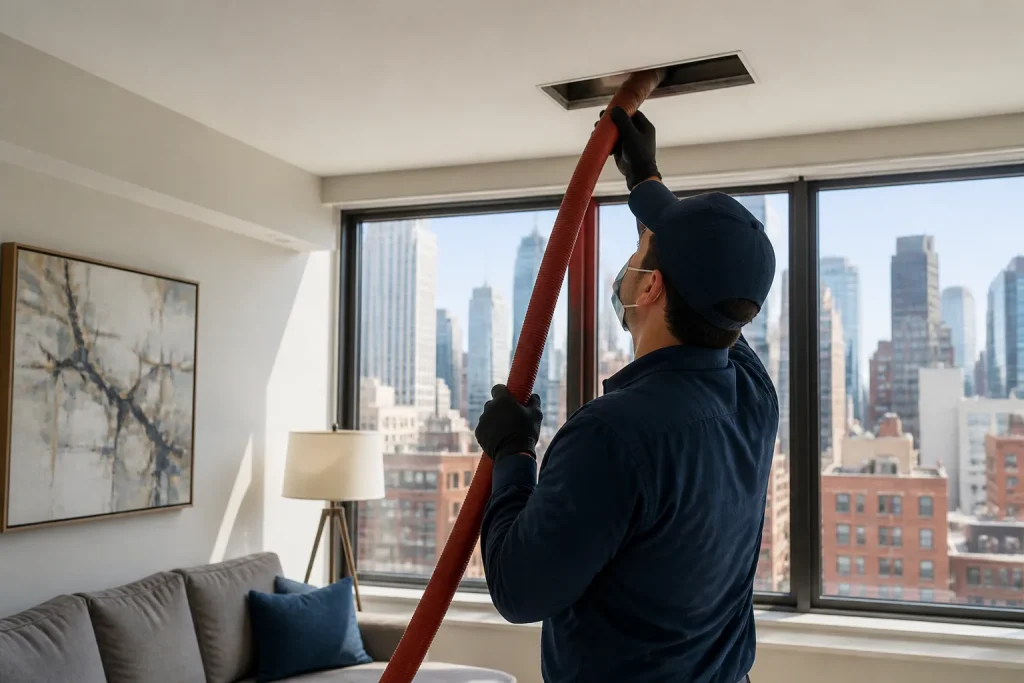
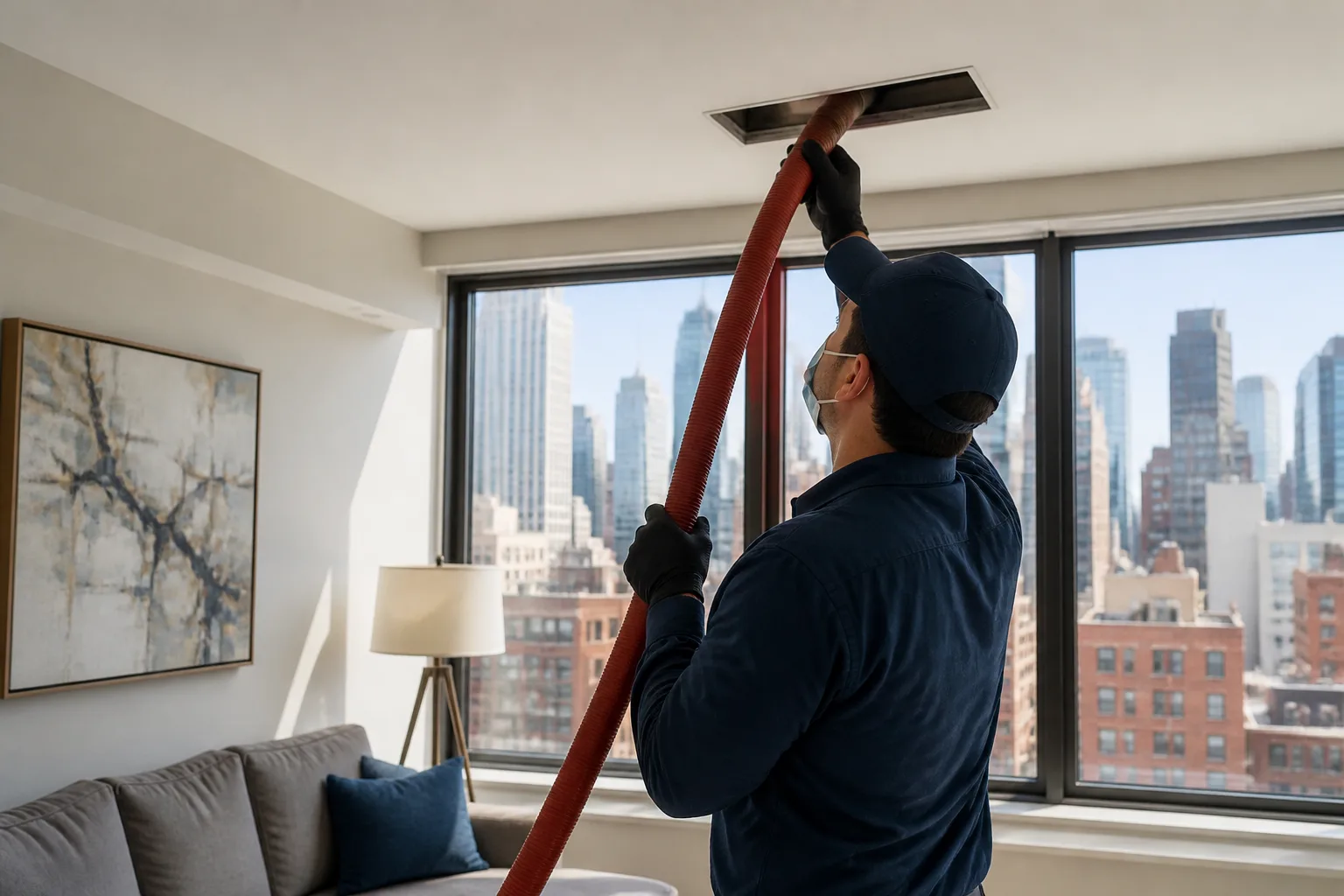
Think of it as two jobs running at once. Rotobrush sends a rotary brush through the duct to break contamination loose from the walls – the caked-on dust, the renovation grit, the film that clings to flexible duct liner. Nikro pulls that loosened material out under negative pressure while it’s still airborne. Together, one agitator plus one collector, you get a clean duct. Run the brush alone and you’ve redistributed dust. Run suction alone and you’ve skimmed the surface.
The Hell’s Kitchen wrinkle is duct material. Older buildings here mix sheet metal with flexible runs, and each takes agitation differently. Flexible duct has ridges and a liner that can tear if a brush is run too aggressively. Rigid sheet metal with tight radius bends – common in apartments squeezed into older floor plans – needs the brush to reach the turns without losing contact. Our technicians have up to 14 years of experience reading which ducts want which approach, and a Rotobrush setup lets them tune that instead of guessing. That’s why you’ll see us describe the scope as the air duct cleaning Hell’s Kitchen work we do, done with the right tool for each section.
Which duct scenarios need Nikro, and how each one changes the job
Not every duct system is the same problem, and a Nikro platform earns its keep on the harder ones. Here’s how the approach shifts depending on what’s in your building.
Post-renovation ducts
A gut renovation leaves drywall dust, joint compound, and fine silica in the system. Those particles are heavy enough to settle but light enough to re-suspend the moment the HVAC kicks on. Nikro’s sustained negative pressure keeps them moving toward the collection point instead of back into rooms you just finished. This is the scenario where cheap equipment fails most visibly.
Flexible duct
Flex runs need lower-agitation brushing and steady, gentle suction. Too much brush speed and the liner abrades. Nikro’s adjustable draw lets the technician match the pull to the material while still clearing the ridges where debris collects.
Tight-radius sheet metal
Prewar apartment layouts often produce sharp bends the brush can’t fully seat in. The vacuum does the heavy lifting here, holding pressure across the whole run while agitation works the reachable sections and the air column clears the rest.
What a Nikro cleaning actually looks like from your apartment
Most residents want to know what to expect before anyone shows up. Here’s the process, start to finish, without the brochure gloss.
- Access points. The technician finds the return and supply grilles, then may open a few additional service points along the trunk line so the equipment can reach every branch. In a typical Hell’s Kitchen apartment, that’s a handful of spots, not a demolition.
- Containment and hookup. Negative-air equipment goes on the system before any agitation begins. You’ll hear a steady low roar – think a powerful shop vac running two rooms away – not a shriek.
- Agitation and extraction. The brush runs while the vacuum pulls. This is the bulk of the work. For a standard Hell’s Kitchen one-bedroom, plan on a couple of hours; larger units and post-renovation jobs run longer because there’s simply more duct and more debris.
- Verification. Before the equipment comes off, the technician inspects and documents. See the next section on why this step matters.
If you’d rather not manage any of this yourself, that’s exactly the moment to call a pro. In our experience, homeowners who ask “how long will this take in my unit?” get a better answer when they describe their building first – number of rooms, duct type if they know it, and whether there’s been recent construction nearby. That’s how we scope a realistic estimate.
Related services in Hell’s Kitchen: if your building also has a dryer tucked into a closet or utility room, our dryer vent cleaning covers the fire-safety side, and a combined visit often makes sense. For full-system upkeep, HVAC cleaning pairs naturally with duct work.
How do you verify a Nikro-based cleaning was actually done right?
This is where the equipment earns trust – or reveals that it wasn’t used. A contractor running a proper Nikro setup should be able to document the result, not just tell you it went well. Ask for these before you pay:
- Before-and-after inspection footage from inside the ducts. A camera inspection shows the actual interior walls, not the grille you can see from the hallway.
- Airflow measurements taken at the registers before and after. If the numbers don’t move, ask why.
- Filter weight or condition comparison – a sanity check that particulates were captured, not just moved.
For deeper peace of mind, the process should extend beyond cleaning: Guardsman-grade sanitizing treatments target allergens, mold spores, and microbial contamination at the source, and for buildings with whole-home filtration tied to Honeywell or Aprilaire systems, the duct cleaning and the filtration check should be handled by the same person who understands how they interact. Pair this with a duct repair and sealing pass if the inspection turns up gaps, and the whole system starts holding pressure the way it was designed to. One call covers cleaning, repair, and sanitizing.
Call (833) 468-5937. We answer 24/7. Fast dispatch from 7am to 7pm, Sunday through Friday.
The Bottom Line
Nikro equipment isn’t a name worth dropping for credibility – it’s a machine with specific capabilities that match the contamination and ductwork conditions common in Hell’s Kitchen buildings. Understanding the CFM, the negative pressure, and the HEPA staging lets you evaluate a quote on substance instead of price alone. Combined with Rotobrush agitation and backed by real verification, it’s industrial-grade equipment producing residential results. If you’re in Hell’s Kitchen and need help, Air Duct Cleaning Hell’s Kitchen offers free estimates – call (833) 468-5937. We answer 24/7, with fast dispatch from 7am to 7pm, Sunday through Friday.
Frequently Asked Questions
Most Hell’s Kitchen apartment cleanings run in the range you’d expect for a professional-grade job, and the exact figure depends on the number of rooms, duct type, and whether post-renovation contamination is involved. We quote one flat price per system by written estimate, agreed before work starts, with no per-vent pricing. Call (833) 468-5937 for an exact quote – estimates are free.
Usually because the equipment isn’t in the same class. A shop vac with a filter taped on and a Nikro portable power vacuum both say “professional” on the invoice, but only one holds true negative pressure and stages HEPA filtration. Cheap quotes often skip verification footage and airflow measurement too, which means you can’t confirm the work happened. Ask what machine they’ll use and what documentation you’ll receive.
Ask for before-and-after camera footage of your own ducts, airflow readings at the registers, and filter condition comparison. A contractor using a proper Nikro setup should provide all three without hesitation. Call (833) 468-5937 if you want a free estimate from a team that documents the result.
Most homes go a few years between cleanings, but post-renovation work, a recent HVAC system, or a home with allergy concerns can justify one sooner. If you’ve remodeled recently, the answer is almost always yes. Call (833) 468-5937 and we’ll help you decide based on your building.
Written by the team at Air Duct Cleaning Hell’s Kitchen.
Need Air Duct Cleaning Help?
Call Air Duct Cleaning Hell's Kitchen - the local pro we connect you with is licensed and insured, here with fast help in Hell's Kitchen.
(833) 468-5937